 EN
EN

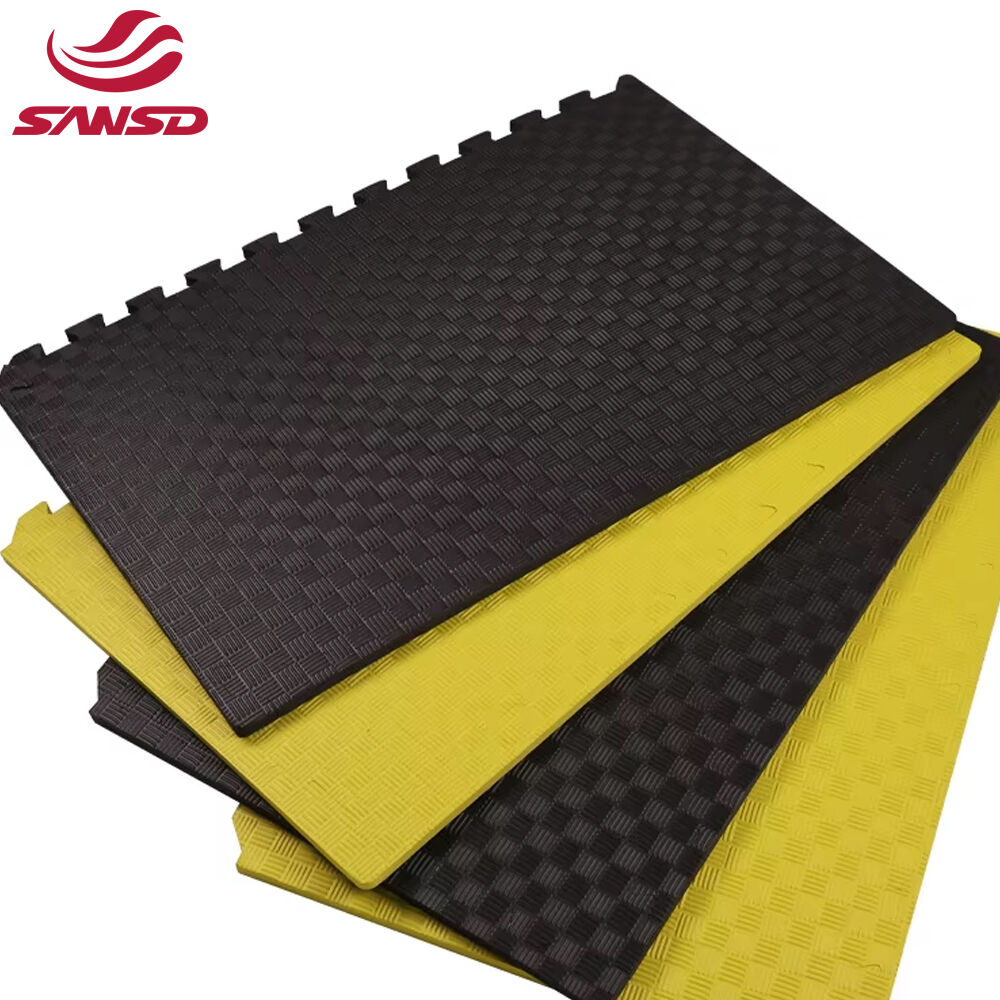
Taekwondo-Specific Durability Demands
High-Impact Landings, Spinning Kicks, and Repetitive Stress Testing
Taekwondo techniques impose extreme durability demands on mats, requiring exceptional resilience against high-impact forces. The repeated impact from jump kicks, spinning maneuvers, and rapid directional changes subjects floor mats to unique stress patterns—far exceeding those of standard gym flooring. Research shows that impact forces during 540° spinning kicks can exceed nine times body weight (Sports Engineering Journal, 2023), necessitating foam cores with superior compression recovery. Mats recovering below 95% after 5,000 impacts fail to provide consistent safety or surface stability. Surface integrity is equally critical: textured topsheets must resist tearing during pivots while maintaining a stable friction coefficient between 0.4–0.6.
ASTM F2772 Compliance and Minimum Thickness-Density Requirements for Taekwondo Floor Mats
Compliance with ASTM F2772 impact attenuation standards is non-negotiable for taekwondo facilities. This standard defines minimum thickness-density combinations essential for both athlete safety and long-term mat durability:
| Parameter | Minimum Requirement | Performance Benchmark |
|---|---|---|
| Thickness | 40mm | G-force reduction ≤150 |
| Density | 120kg/m³ | Rebound ≤65% |
| Critical Fall Height | 1.2m | HIC ≤500 |
Mats under 35mm consistently fail compression set tests after six months of daily use. High-density closed-cell foams (120–140 kg/m³) demonstrate 83% better fatigue resistance than standard PE foams in accelerated aging tests. Crucially, density must scale with thickness—a 50mm mat requires ≥140 kg/m³ to prevent bottoming out during consecutive jump kicks. This density-thickness synergy reduces replacement frequency by 40% compared to non-compliant options (Facility Operations Report, 2024).
EVA vs. XPE Foam: Durability Performance Breakdown
When choosing taekwondo floor mats, the foam core determines how well the surface withstands years of high-intensity training. Two common materials—EVA (Ethylene Vinyl Acetate) and XPE (Cross-linked Polyethylene)—offer distinct durability profiles. Compression set and abrasion resistance are the two most decisive metrics for dojo floors.
Compression Set Resistance After 5,000 Cycles (1.2m Drop Test)
Compression set measures permanent deformation after repeated impact. In lab testing simulating roundhouse kick landings—5,000 drops from 1.2 meters—XPE foam retains over 92% of its original thickness, while EVA retains only 85–88%. XPE’s cross-linked molecular structure prevents cell wall collapse under sustained load, delivering greater long-term resilience. Though EVA rebounds slightly faster between strikes due to higher vinyl acetate content, its lower compression resistance leads to visible thinning zones and inconsistent surface height over time—especially where athletes repeatedly land or roll. For taekwondo, where foot placement precision and landing consistency are paramount, XPE’s superior recovery preserves flatness and safety far longer.
Abrasion Resistance and Surface Integrity in 12-Month High-Use Simulation
Surface wear directly affects grip, hygiene, and injury risk. In a 12-month accelerated wear simulation—mimicking eight hours per day of sparring, dragging, sweeping, and pivoting—XPE loses just 0.3 mm of its top layer, while EVA loses 0.8 mm. XPE’s fine, closed-cell architecture resists scuffing, powdering, and grain disruption. EVA’s softer surface offers strong initial grip but degrades faster under rotational friction, often becoming rough or tacky after one year. For competition-level training, even minor texture shifts can alter spin velocity or increase slip risk. XPE’s proven surface integrity makes it the preferred choice for high-traffic dojangs committed to performance consistency and athlete safety.
The Density-Hardness-Thickness Triad: Optimizing Taekwondo Floor Mats for Longevity
Why 120–140 kg/m³ Density Is the Durability Sweet Spot for Taekwondo Floor Mats
Density is the cornerstone of durability in taekwondo mats—balancing shock absorption with structural resilience. At 120–140 kg/m³, foam resists permanent deformation from high-force techniques like spinning kicks while avoiding excessive stiffness that increases joint strain. Lower-density foams compress too deeply, losing rebound consistency; higher densities sacrifice comfort without meaningfully extending service life. This range aligns precisely with ASTM F2772 requirements and delivers three key benefits:
- Compression resistance: Full rebound after thousands of impacts
- Stability: Uniform firmness supports precise footwork and balance
- Long-term integrity: Resists tearing, delamination, and pivot-induced surface fatigue
Pair this density with a 40–50 mm (1.5–2 inch) thickness to optimize force distribution—and match with a Shore A hardness of 25–35 to prevent surface cracking or excessive bounce. Mats engineered within this triad routinely exceed five years of daily dojang use without performance degradation.
FAQ
What is the ASTM F2772 standard for taekwondo mats?
The ASTM F2772 standard defines the minimum thickness and density requirements for safety and durability of floor mats used in taekwondo facilities. It includes parameters like G-force reduction, rebound levels, and critical fall height.
Why is XPE foam preferred over EVA for taekwondo flooring?
XPE foam offers superior resistance to compression set and abrasion. It retains up to 92% of its original thickness after extensive use, while also maintaining surface integrity better than EVA, making it ideal for high-intensity training environments.
What density and thickness are ideal for taekwondo floor mats?
A density of 120–140 kg/m³ paired with a thickness of 40–50 mm is optimal for taekwondo mats. This combination balances shock absorption, prevents bottoming out, and ensures long-term durability without compromising comfort.
What makes surface integrity important in taekwondo mats?
Surface integrity affects grip, hygiene, and injury prevention. A well-maintained surface ensures consistent foot placement, reduces slip risk, and withstands wear from high-traffic activities like sparring and kicking drills.
How long do high-quality taekwondo mats typically last?
High-quality mats engineered with the right density, thickness, and materials can last more than five years of daily use in a professional dojang without performance degradation.