 EN
EN

Beyond Off-the-Shelf: What Makes Customizable Foam the Smart Choice for Industrial Buyers
Standard foam sheets serve generic applications adequately, but specialized manufacturing demands materials engineered to exact specifications. Customizable foam — produced with adjustable density, hardness, thickness, color, and surface texture — eliminates the compromises that come with catalog-stock products. From automotive interior trim to medical device packaging, tailored foam solutions reduce assembly time, minimize waste, and improve end-product consistency.
The Science Behind Customizable Foam Formulation
How Polymer Blending Creates Tunable Mechanical Properties
Customizable foam begins at the compounding stage. Base polymers — predominantly EVA (ethylene-vinyl acetate) — are mixed with blowing agents, crosslinking agents, fillers, and color masterbatches in precise ratios. The VA (vinyl acetate) content in EVA determines baseline flexibility: 18% VA yields firmer foam suited for structural applications, while 28% VA produces softer, more elastic material for cushioning and gasketing.
Blowing agent concentration controls density. Azodicarbonamide, the industry-standard chemical blowing agent, decomposes at 190–230°C to release nitrogen gas. Higher concentrations produce lower-density foam with larger cell structures; lower concentrations yield denser, stronger material. A 0.5% adjustment in blowing agent ratio can shift foam density by 8–12 kg/m³.
Crosslinking density — achieved through peroxide or electron-beam curing — governs compression set resistance and thermal stability. Higher crosslink density improves recovery after compression but reduces elongation at break. Formulators balance these trade-offs based on the application's mechanical demands.
Why Thickness Tolerance Matters in Precision Applications
Off-the-shelf foam sheets typically carry thickness tolerances of ±1.0mm or wider. For gaskets in waterproof enclosures or vibration-damping pads in optical equipment, this variation can compromise seal integrity or alignment precision. Customizable foam from manufacturers with precision calendaring or skiving equipment achieves tolerances down to ±0.3mm across full sheet dimensions.
Sansd (Jiangsu) Environmental Technology operates 12 EVA production lines with in-line thickness monitoring, enabling consistent output across production batches exceeding 10,000 sheets. This repeatability proves critical for buyers integrating foam components into automated assembly lines where dimensional drift triggers jams or rejects.
Real-World Application: Automotive Interior Supplier
A Tier-2 automotive supplier producing door-panel armrest pads faced two problems: the standard 5mm EVA foam they purchased required hand-trimming to fit their die-cut shapes, generating 18% scrap; and the foam's 55 Shore C hardness caused tactile complaints from OEM quality auditors. After switching to a pre-scored 4.8mm customizable foam roll at 38 Shore C — formulated with a higher VA content (26%) and pre-laminated pressure-sensitive adhesive — scrap fell below 4%. The softer touch passed OEM sensory evaluation on the first submission. Annual material cost decreased 11% despite the higher per-sheet price, entirely driven by reduced waste.
Selecting the Right Customizable Foam Parameters
Closed-Cell vs. Open-Cell: Matching Structure to Function
Closed-cell customizable foam suits applications requiring water resistance, buoyancy, and thermal insulation. Each cell remains sealed, preventing liquid or gas penetration. Open-cell foam, by contrast, breathes — making it preferable for acoustic absorption, filtration, and cushioning where air permeability is desirable. A medical device manufacturer specifying foam for wound-care padding selected open-cell polyurethane for its moisture-wicking behavior, while the same company used closed-cell EVA for waterproof equipment case inserts.
Color and Surface Finish Options
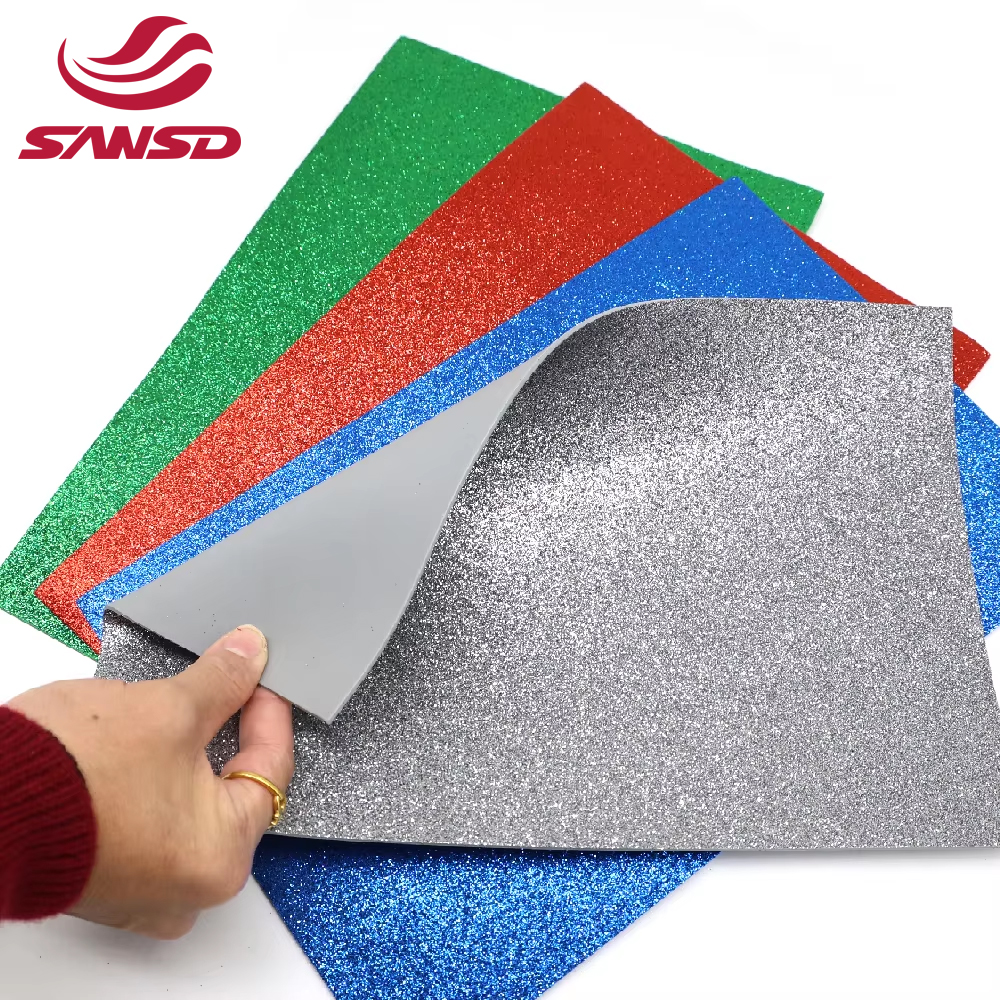
Customizable foam accepts pigmentation across the full color spectrum. UV-stable formulations resist fading for outdoor applications like marine seating and playground surfacing. Surface finishes range from smooth (calendered) to textured (embossed), with embossed patterns providing enhanced grip for yoga mats and anti-slip flooring. Laminated films — including TPU, fabric, and metallic foils — bond to the foam surface during manufacturing, creating multi-layer composites without secondary adhesive processes.
Frequently Asked Questions
What typical minimum order quantity applies to customizable foam orders?
Minimum order quantities vary by specification complexity. For custom color and density combinations, Sansd (Jiangsu) Environmental Technology typically requires 200–500 sheets per specification. Standard-density sheets with simple dimensional cutting can be ordered in smaller batches below 100 sheets. Die-cut shapes with new tooling often start at 1,000 pieces due to initial setup costs and mold fabrication.
How long does custom foam formulation take?
Standard formulation adjustments (density, hardness, color) typically require 5–7 working days for sampling. New color matching or tight-specification development may extend to 10–14 days. Full production runs follow within 15–25 days after sample approval.
Can customizable EVA foam include fire-retardant properties for regulated applications?
Yes — fire-retardant additives such as aluminum trihydroxide or phosphorus-based compounds can be incorporated during compounding to meet FMVSS 302 (automotive), BS 5852 (furniture), or FAR 25.853 (aerospace) flammability standards. These formulations increase material cost by approximately 20–30% depending on the required rating and certification level.
What density range is achievable with EVA foam?
Standard EVA customizable foam ranges from 25 kg/m³ (ultra-soft, lightweight) to 200 kg/m³ (dense, structural). Most packaging and cushioning applications use 30–80 kg/m³. Shoe sole and industrial gasket applications typically require 60–120 kg/m³ for mechanical durability.
Does custom foam processing significantly affect export order lead times?
Container-load export orders with custom specifications from Sansd typically ship within 25–35 days from order confirmation. Rush orders with existing tooling and approved formulations can ship in 15–20 days for urgent client requirements. Sea freight transit to major European and North American ports adds 25–40 days depending on destination port and shipping lane availability.
Is customizable foam compatible with adhesive lamination?
Yes — EVA and PE customizable foam bond well with pressure-sensitive adhesives, hot-melt adhesives, and solvent-based bonding systems. Corona or plasma surface treatment before lamination improves peel strength by 40–60% compared to untreated foam surfaces.